Written By: Nicholas Cocks
Earlier this month, I attended the Singapore Hotel Association (SHA) Hospitality Exchange where Meta presented new research on the role of social media in travel. The numbers confirmed what we at Velocity Ventures have long argued: social platforms are not just amplifiers of marketing. They have become the primary engines of demand generation.
Yet a major problem remains. Social media excels at sparking desire but fails to close the loop. Travellers who discover a destination rarely book it in the same place. Instead, they leave the app, search on Google, browse an OTA, or transact directly on a supplier site. The magic of discovery is interrupted by friction. For consumers, it means a fragmented booking journey. For platforms and suppliers, it means lost monetisation.
This lack of seamlessness is one of the largest inefficiencies in travel distribution today. Enormous value is created at the top of the funnel but captured elsewhere. For us as investors, this is not just a structural flaw, it is the next frontier of value creation.
Social Media’s Growing Influence
At the SHA conference, Meta shared eye-opening data from Expedia’s Path to Purchase report, among other sources. 77 percent of travellers use social media during the inspiration phase of their journey, while 58 percent engage with it somewhere along the booking funnel. In other words, social media is no longer just a spark. It is embedded in how modern consumers dream, research, and plan.
Video is central to this shift. Sixty percent of all content on Facebook and Instagram is now video, and half of Instagram usage is Reels. Every day, 4.5 billion Reels are shared across Meta platforms. Travel content is especially powerful: it is consumed at 16 times the rate of average content. TikTok echoes this trend, reporting that travel content views have grown fivefold since 2021, with 82 percent of UK users finding travel inspiration on the platform.
Creators are the accelerants. Meta highlighted that 55 percent of travellers discover new brands through Reels, while 53 percent are more likely to purchase if a trusted creator promotes it. This isn’t about glossy campaigns anymore. It’s about authenticity and trust, which increasingly drive distribution advantage.
Taken together, these signals make one conclusion clear, social media has become indispensable to travel demand. And yet, despite all this influence, the funnel still leaks where it matters most. Social inspires and shapes intent, but bookings typically happen elsewhere. That break is both a consumer frustration and an investor’s opportunity.
The Broken Funnel and Why It Persists
The behaviour is familiar. A traveller sees a boutique hotel in Bali on Instagram, then leaves the app, searches Google, checks rates on Booking.com, and books on a supplier site. The platform that generated demand loses the transaction.
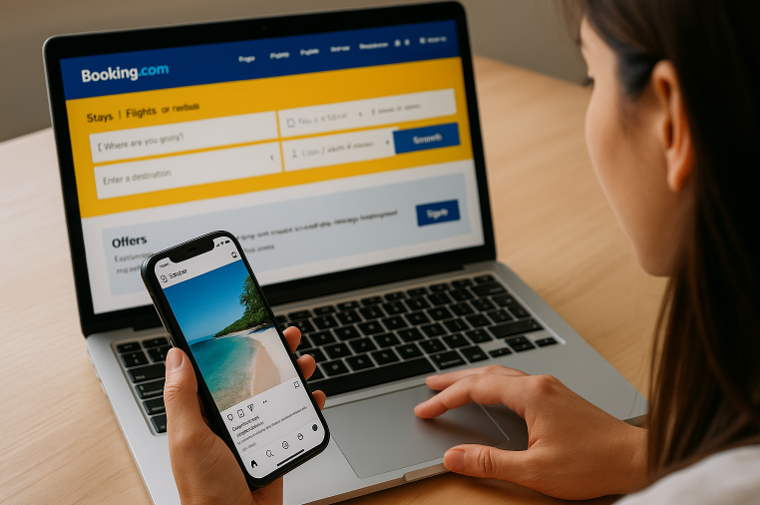
Tripadvisor shows how difficult it is to monetise inspiration. It built one of the most trusted ecosystems of reviews and photos. Yet its “Instant Booking” initiative failed to scale, and by 2017 the company reverted to referral-heavy models. Influence without seamless conversion proved nearly impossible to monetise.
However, it is not that consumers are unwilling. A Skift survey found that 54 percent of travellers would book flights and hotels directly on social platforms if the functionality and inventory were available. The barrier is execution: reliable supply, seamless UX, and consumer trust at checkout.
So why has no one solved this yet? The answer lies in incentives. OTAs like Booking.com and Expedia built their businesses on owning the checkout stage. That is where they capture commissions and control the customer relationship. If bookings were to shift onto social platforms, OTAs would lose both margin and leverage. Hotels and airlines face a similar dilemma. They depend on OTAs for reach but already worry about losing control of their brand and customer data. Handing bookings to third-party apps like TikTok or Instagram only deepens that concern.
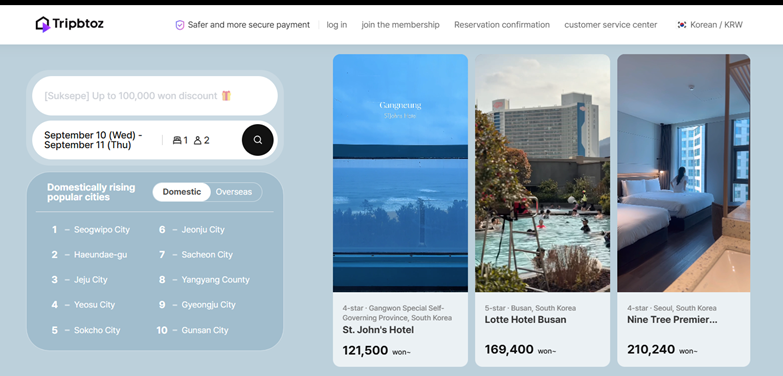
There are also structural challenges. Unlike fashion or beauty, travel purchases are high-ticket, infrequent, and logistics heavy. That makes it harder to simply copy social-commerce models into the sector. Yet platforms like Xiaohongshu in China and Tripbtoz in Asia are showing that it is possible to merge content, community, and commerce in ways tailored to travel. Their early success highlights how new models can overcome structural barriers and reshape how inspiration is converted into bookings. This is why innovators tackling this issue of seamlessness is so valuable.
Innovators Tackling the Pain Point
A wave of players are now racing to close the gap between inspiration and booking. They are accomplishing this through various methods and business models.
Platform partnerships: TikTok is testing in-app hotel bookings with Booking.com, allowing users to check availability and confirm stays without leaving the app. Its TikTok Go program lets creators earn commissions when their content drives bookings, embedding monetisation into the creator economy.
Integrated ecosystems: Startups are also building platforms designed for seamlessness from the ground up. Tripbtoz, a Velocity Ventures portfolio company, merges authentic travel videos with direct booking to keep the user journey in one place. By combining content, community, and commerce, much like Xiaohongshu, Tripbtoz captures monetisation at the moment of highest intent.
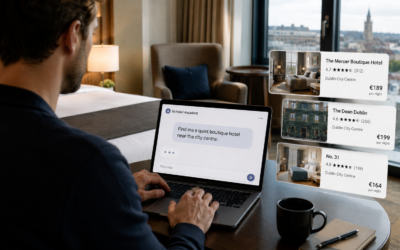
AI as the bridge: Expedia’s Trip Matching tool lets users forward Instagram Reels and receive AI-generated, bookable itineraries. GuideGeek, developed by Matador Network, acts as an AI concierge across Instagram, WhatsApp, and Messenger, providing personalised suggestions that can lead straight into booking. These tools reduce friction from intent to action, even if they still hand off to external systems for final checkout. Beyond brand-specific tools, general-purpose AI agents are pushing the boundary further. A new report by Statista showed that nearly 40% of travellers have already used AI tools to plan a trip, and it won’t be long before AI takes over the entire process. Perplexity now enables direct hotel bookings within its answers interface, tapping into Tripadvisor reviews and Selfbook inventory to deliver transactions within the same flow. Similarly, Anthropic’s new release mimics a human travel agent by autonomously navigating the booking process on users’ behalf. These developments signal a shift where AI isn’t just assisting travel planning, it’s orchestrating it end-to-end…potentially making the consumer journey completely seamless.
Conclusion
Social media has already won the battle for inspiration. It is where travellers dream, discover, and evaluate. Yet the funnel still breaks at the most critical stage, booking. That inefficiency costs platforms and suppliers billions in lost value and leaves consumers with fragmented experiences.
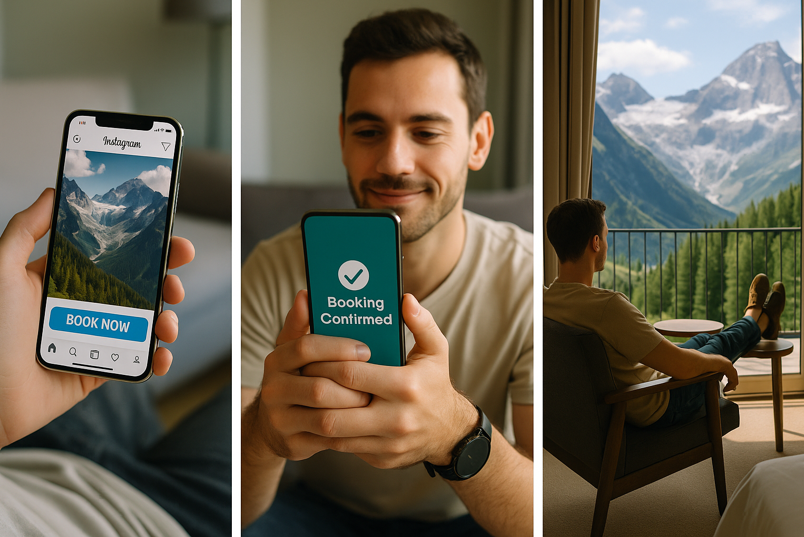
The winners of tomorrow will be those who close this gap. Whether through TikTok’s integrations, AI-driven assistants like GuideGeek, or integrated ecosystems like Tripbtoz, the objective is the same: make inspiration directly bookable.
AI will accelerate this shift by collapsing the planning window and personalising discovery in real time. Creators will evolve into travel sellers, embedding commerce into their communities. And the economics of distribution will shift away from incumbents who defend margins toward platforms that enable seamless conversion.
At Velocity Ventures, we believe this is where the next wave of value in travel will be created. The future belongs to those who can transform the journey from scroll to stay into a seamless reality.