
How conversational search is reshaping hotel discovery, trust and booking
Written by: Nicholas Cocks
AI is not replacing hotel booking overnight. It is first changing which hotels travellers discover, trust, and consider.
For twenty years the contest for a hotel booking was fought across a handful of well-understood channels. Travellers searched, compared and clicked; hotels and intermediaries spent heavily to be the destination of that click. Artificial intelligence is now rewriting the rules of both halves of the journey — how a guest discovers a property, and how the reservation is ultimately made. This is a once in a generation shift that we are watching very closely at Velocity Ventures and, in this briefing, we will seek to unpack these changes, first looking at the historic channel mix and its economics, then at how AI is bending those shares, the tools hotel groups are using to stay visible, and the central questions of the moment: is AI a discovery tool, or a discovery and booking tool? And, where are the opportunities?
The Historic Channel Mix
Hotel distribution has long been a balancing act between reach and margin. The two heavyweight channels are online travel agencies (OTAs) and the hotel’s own direct channels, with metasearch sitting between them as a comparison layer. OTAs such as Booking.com and Expedia help hotels reach travellers, but usually charge commissions. Direct bookings through a hotel’s own website or app are more profitable because the hotel keeps the guest relationship. Loyalty acts as the lever hotels pull to win direct business and competes with the massive performance marketing spend that drives travellers to OTAs.
Direct booking — brand.com, the app and the call centre — is the higher-margin prize, and the loyalty programme is the engine behind it. Members are extraordinarily valuable: in 2025 they accounted for around 75% of Marriott’s U.S. room nights and 68% globally, with similar penetration at Hilton.4 Industrywide, loyalty members made up roughly 53% of occupied U.S. rooms.
Metasearch — Google Hotels, Trivago, Kayak — is not a booking channel in its own right but the comparison shelf that feeds the others, surfacing live rates from both OTAs and direct sites. Google’s decision to retire commission-based bidding in 2024–25 reshaped how hotels buy that visibility.
| Channel | Approx. share | What it is / why it matters |
| OTAs | ~50–60% | Booking, Expedia, Trip and peers. Largest single source of online hotel gross bookings; commissions of 15–25%. In 2024 OTAs edged direct on gross bookings (OTAs $266bn vs Direct $262bn). |
| Direct (brand.com / app / phone) | ~30–40% | Hotel-owned channels. Higher margin and owns the guest data. Forecast to overtake OTAs by 2030 (Direct $400bn+ vs OTAs $333bn). |
| Metasearch (Google Hotels, Trivago, Kayak) | Influences most online searches | Not a booking channel in itself — a comparison layer that feeds direct and OTA. Google dominates; it retired commission bidding in 2024–25. |
| Loyalty-driven direct | Subset of direct | Members drove ~75% of Marriott U.S. room nights (68% global) in 2025; ~62% at Marriott & Hilton historically. The engine behind the direct push. |
| GDS / TMC (corporate) | Remainder | Corporate and travel-management bookings. Stable but a smaller slice for most leisure-led properties. |
How AI Is Bending the Shares
The clearest early effect of AI is happening at the top of the funnel: discovery. Travellers are beginning to move away from the traditional search box and towards conversational planning. Use of generative AI for travel planning more than doubled from 6% in late 2024 to 15% by mid-2025, while traditional search-engine use for the same task fell from 51% to 36%.
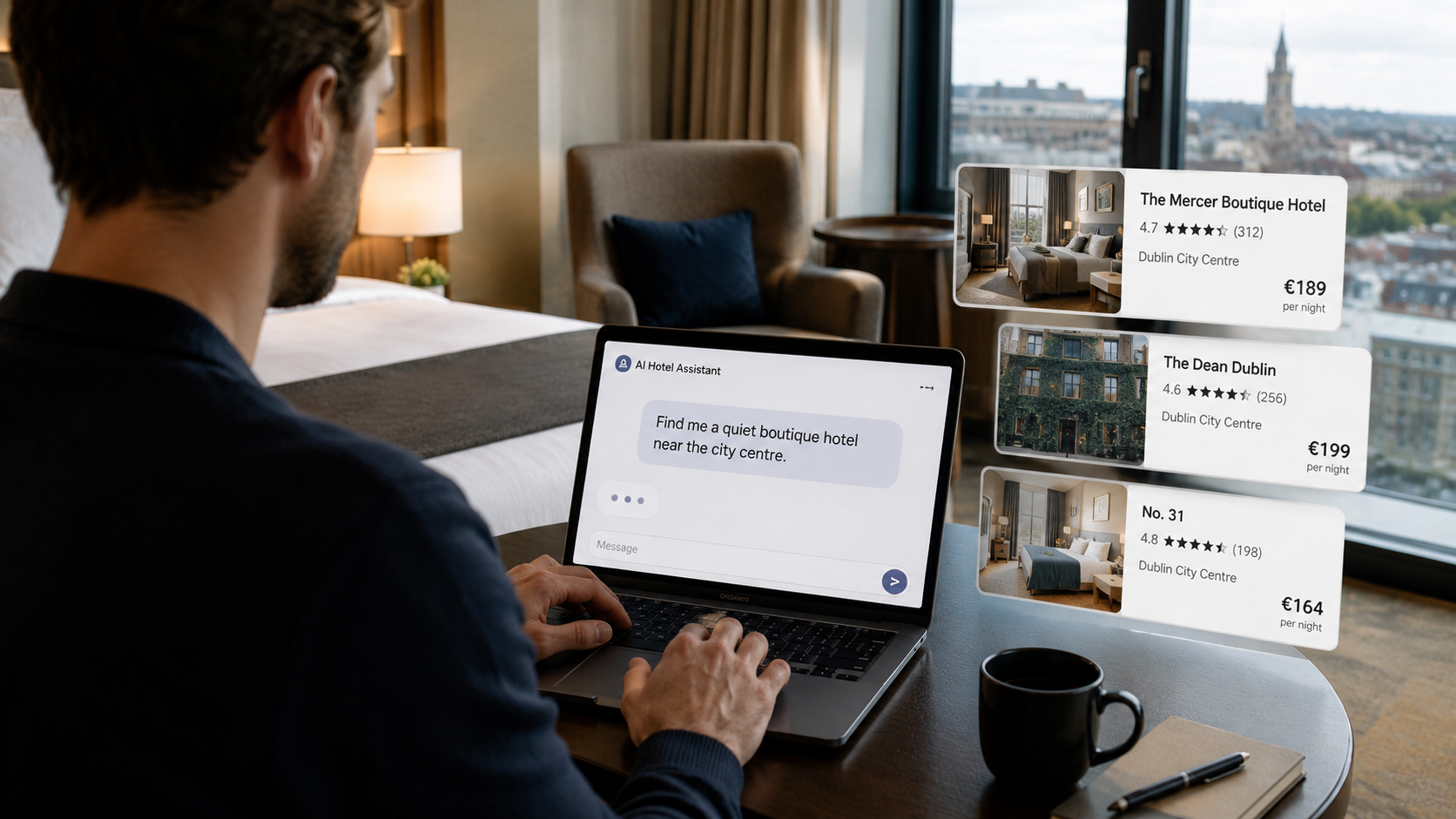
This matters because AI compresses discovery. Instead of browsing dozens of links, a traveller may ask an AI assistant for a shortlist of hotels that fit their budget, location and preferences. Visibility inside that shortlist is becoming the new battleground.
Most hotels are not yet well positioned for this shift. One index of 131,000 properties found that only around 16% of global hotel supply appears in results across ChatGPT, Google’s AI and Perplexity. Chain-affiliated properties are far more likely to surface than independents, creating a potential two-tier system between hotels the models recognise and those they do not.
Early search data points in the same direction. Propellic found that keywords triggering Google AI Overviews rose 558% in two months, but organic click-through rates for affected queries roughly halved from 1.41% to 0.64%. Being cited in the AI Overview lifted CTR back to about 1.02%, but still below traditional search levels.
The implication is clear: discovery is not disappearing, but it is consolidating into AI-generated answers. The prize is shifting from ranking on a search page to becoming one of the sources, properties or brands that the AI assistant chooses to recommend.
The Tools Hotel Groups Are Using to Stay Visible
If guests are increasingly finding hotels through AI, the job is to make sure the AI knows about your property and recommends it. Hotels are doing this in three practical ways.
- Tidy up the basics. Make sure room details, prices, amenities, photos and policies are accurate, up to date and consistent everywhere they appear. AI tools struggle with messy, contradictory or out-of-date information — and simply skip properties they can’t read clearly.
- Write content the AI will quote. Give clear, direct answers to the questions travellers actually ask (“Is it good for families?”, “How far to the beach?”). Build genuinely useful pages — honest comparisons, real guest tips, current offers — that AI bots can digest, even in formats that might be cumbersome for humans. Being mentioned on widely-trusted sites such as review platforms and YouTube helps too.
- Connect directly to the AI platforms. New partnerships let a hotel’s live rates appear inside tools like ChatGPT, Gemini and Claude, with the booking completed on the hotel’s own site. Hotels are also starting to track how often AI tools mention them, the same way they once tracked their position on Google.
Discovery Tool, or Discovery and Booking Tool?
For now, AI is mainly a discovery tool. Travellers are increasingly using AI to search, compare and shortlist hotels, but most are not yet fully comfortable letting AI complete the booking on their behalf. This creates a clear trust gap: people may allow AI to suggest where to stay, but when it comes to payment, cancellation policies and customer support, they still prefer trusted travel brands.
That gap is beginning to close. Platforms such as Perplexity, ChatGPT and Google are already building ways for travellers to move from AI-powered discovery into actual booking flows. This means the hotel booking journey could shrink from a long process of searching across multiple sites into a single conversation where the AI assistant recommends, compares and eventually transacts.
The strategic question for hotels is therefore changing. It is no longer just about winning the click from Google or an OTA. It is about becoming visible, trusted and bookable inside the AI assistant itself.
OTAs will not disappear. In fact, they are well positioned because they already have large inventories, strong brands, trusted payment systems and major marketing budgets. The fight between OTAs and direct hotel channels will continue, but the battleground is shifting from search results to AI-driven conversations.
For hotels, the implication is simple: discovery is moving into AI, while booking may split between AI-assisted direct bookings and agentic intermediaries. The winners will be those who make their data easy for AI to read, their booking path easy to complete, and their brand trusted enough for travellers to act on.
Where the Openings Are for Start-ups
This upheaval is creating room for new entrants, and money is pouring in. PhocusWire’s 2026 “Hot 25” travel start-ups had together raised more than $3.3bn — the largest concentration of AI-native funding the sector has seen — with ten of them founded in just 2024–25.12 The opportunities cluster in a few clear gaps.
- Connecting hotels to the AI platforms. Someone has to feed accurate, live hotel data into ChatGPT, Gemini and Claude. DirectBooker — founded by former leaders of Google Travel and Tripadvisor — is doing exactly this, and has already signed five of the ten largest hotel chains and gone live inside ChatGPT and Claude.13
- Making smaller hotels visible. Only about a sixth of the world’s hotels currently show up in AI results, and independents are the most likely to be missing. Tools that get a single property found, recommended and booked through AI serve a very large, underserved market. Zuzu, a Velocity Ventures portfolio company is tackling this challenge head on.
- Tying the whole trip together. No one yet owns the layer that pulls flights, hotels, cars and preferences into one reliable, bookable plan – despite the majors having touted this goal for years. New agentic platforms are forming around this for specific audiences — luxury travellers, corporate travel — rather than trying to serve everyone at once.
- Trust, payments and measurement. Because travellers still hesitate to let AI spend their money, there is room for start-ups that make agent payments safe and reversible, verify that an agent is acting on a real person’s instructions, and measure how often — and how favourably — AI tools mention a given brand. The challenge here is the beating the agents who have massive budgets to win the trust battle.
The common thread is focus. The bundled travel agency is being pulled apart, and the winners tend to do one thing extremely well, then plug into the wider ecosystem. With hotels budgeting an average of around $320,000 each on AI in 2026, there is a real customer base for tools that solve these problems convincingly.13
Conclusion
AI has already changed hotel discovery and is now reaching into booking. The near-term picture is a discovery tool feeding a still largely conventional booking world — but the infrastructure to close that gap is being laid in real time. The hotels that prosper will treat their data as a distribution strategy, not an IT task; optimise for being the answer rather than the link; and move early to earn the traveller’s permission to act. As both AWS and Propellic conclude: own the trust, own the data, and make yourself legible to the machine — because increasingly, the machine will book the room. For nimble startups, the prize is there for the taking – helping hotels solve these problems can be the makings of a successful business.
Sources
1. Skift Research, Hotel Distribution Outlook 2024; reporting via Skift, 2024–25.
1a. Phocuswire by Northstar 6 June 2026.
2. Prostay, Hotel Booking Statistics 2026; EHL Hospitality Insights, 2025–26.
3. Cloudbeds, 2026 State of Independent Hotels Report, via Asian Hospitality, 2026.
4. Marriott International 2025 Annual Report; CBRE, Hotel Loyalty Programs, 2024–25.
5. EHL Hospitality Insights, citing Skift/Statista on generative-AI travel planning, 2025.
6. HotelWorld AI, World’s Best at AI 2025 Index, via PhocusWire, 2026.
7. Hospitality Net brief, citing LLM platform traffic data, January 2026.
8. Propellic, AI Strategy Guide (propellic.com/blog/ai-strategy-guide), 2025–26.
9. Amazon Web Services, The Agentic Commerce Shift, 2026.
10. Expedia Group, AI Trust Gap report; SiteMinder, Changing Traveller Report 2026, via Hospitality Net, 2026.
11. SiteMinder press materials and PhocusWire/Skift coverage; Google for Developers, UCP for Lodging, 2026.
Key references: Propellic, AI Strategy Guide — propellic.com/blog/ai-strategy-guide; and AWS, The Agentic Commerce Shift: How Travel & Hospitality Will Win the AI Era (2026).