
Written by Jonathon Cocks
The pandemic is over and the “travel rebound” has come and gone. Yet even as airports buzzed back to life, new risks have emerged, once again making both travellers and the industry watchful about the future of global travel. Global conflict looms large, with Russia’s invasion of Ukraine and the ongoing conflict in Israel and Gaza. In addition, trade wars threaten to damage economies. All this is leading once again to fears that a drop in travel is imminent.
Nobody can say for sure whether these wars will spread or whether GDP will fall, but we can at least look to the data to see if similar events in the past have caused travel to suffer.
To start this off, let’s first look at travel levels. Based on data on international arrivals collected by the World Bank, sharp drops in travel are rare. But when they do happen, the effects ripple across the sector. From airlines and hotels to the people who depend on them. There have only been a few times in the past 50 years where arrivals have either grown by less than 2% year-on-year, or dropped: 1991, 2001, 2003, 2008, 2009, and 2020.
To understand what’s really at stake for travellers, businesses, and the entire industry, it’s worth breaking down the main causes of travel risk: pandemic, war, and recession.
Pandemics: Beyond the Numbers
The end of the 20th century was a relatively safe period after several deadly pandemics earlier in the century. However, the 21st century would unfortunately end that streak with the following:
- 2003 – Severe Acute Respiratory Syndrome (SARS CoV-1)
- 2012 – Middle Eastern Respiratory Syndrome (MERS)
- 2020 – SARS CoV-2 (COVID-19)
War and Travel: When Conflict Disrupts Journeys:
In terms of global travel, regional wars can be excluded due to their localised impact. Our list will only include wars with active participation from a G8/G7 country as these are the most likely to cause travel disruptions:
- 1991 – Gulf War
- 2001 – War in Afghanistan
- 2003 – Iraq War
- 2014 – Ukraine Crimea Conflict
- 2022 – Ukraine Conflict
- 2023 – Israel/Gaza Conflict
Recessions: How Economic Downturns Ripple Through Hospitality
Using global GDP as a metric, we can identify the following years where global GDP fell compared to the previous year:
- 1997 – Asian Financial Crisis
- 2001 – Bursting of the Dot-com Bubble
- 2009 – Global Financial Crisis
- 2015 – Global Trade Slowdown
- 2020 – COVID Lockdowns
When these events overlap, the impact is not just theoretical; travel plans are shelved, hotels see cancellations, and the broader sector feels the strain. Here’s how past events have aligned with actual drops in travel:
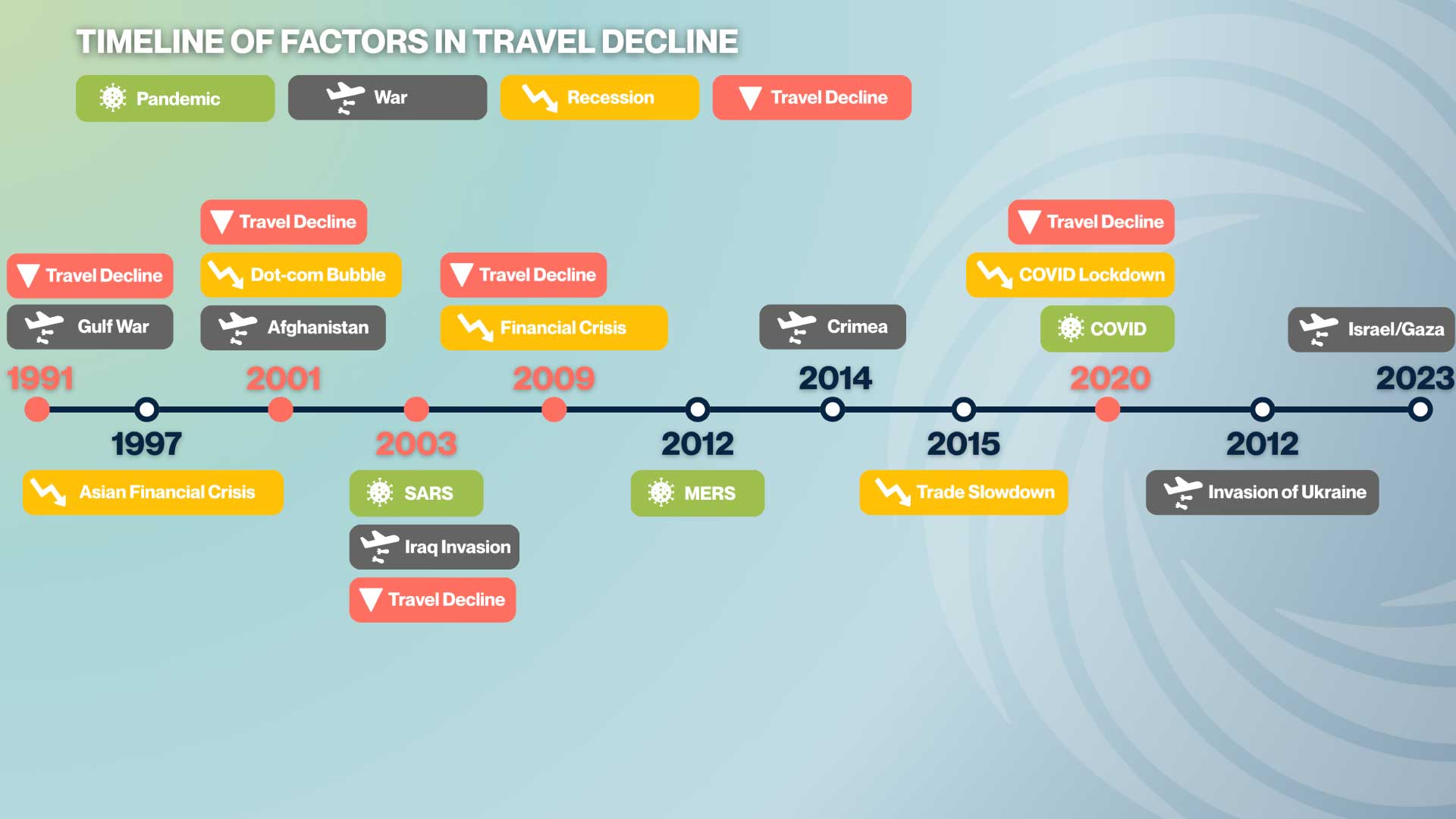
Looking At the Timeline, We Can Draw the Following Conclusions
- 2 out of 3 (67%) pandemics coincided with a decline in travel, with only 1 (33%) occasion when pandemic was the sole coinciding event.
- 3 out of 6 (50%) wars coincided with a decline in travel, with 2 (33%) being the sole cause. However, we should note that 2 of the 6 wars occurred during the unprecedented post-COVID travel rebound, so any decline caused by war may be hidden beneath a much larger post-covid rebound.
- 4 out of 5 (80%) recessions coincided with a decline in travel. A statistic that’s top of mind for operators and investors as they consider how best to navigate uncertainty.
- 3 out of 5 (60%) travel declines coincided with more than one cause, while 2 out of 5 (40%) coincided with only a single cause.
- 2 out of 8 (25%) times where only one cause occurred resulted in a drop in travel (namely the Gulf War and the Global Financial Crisis). All other declines required two causes to trigger a drop in travel.
- 3 out of 3 (100%) times where two causes occurred simultaneously resulted in a drop in travel.
In Terms of Predicting Future Declines in Travel, We Can Say the Following:
- Recessions by themselves rarely cause travel to decline, but when they occur together with other triggers, the impact is more significant.
- Pandemics need to be severe to have any real impact.
- Wars also need to be severe to impact travel, though their effect may be larger than the data currently suggests.
The data suggests that a significant expansion of current conflicts, especially if combined with economic headwinds caused by the current trade war, could impact travel globally. For those working in the industry, or simply planning their next trip, these risks are important to watch but history also shows that travel, while vulnerable, has proven adaptable in the face of uncertainty.
That said, the periods of reductions in travel experienced over the last 50 years have been minimal (rarely more than a 2% drop, and often only no growth) with Covid-19 being the only extreme and dramatic event to hit travel numbers. So although the chances of a “double-hit” of war and recession hitting in 2025/2026 are real, we can expect any negative outcomes for travel numbers to be minimal.