
The Current Chess Game – A One-Sided Battlefield
For years, the travel industry has been a master of dynamic pricing. Hotels and airlines, equipped with sophisticated algorithms, have meticulously adjusted prices in real-time based on a myriad of factors: demand, seasonality, competitor pricing, booking lead time, historical data, local events, and even the type of device you’re using. The goal is simple in an industry where the variable costs of the next traveller are minimal: maximize revenue by charging each customer the highest price they are willing to pay at a given moment.
In the hotel space, this “supply-side” intelligence is dominated by powerful Revenue Management Systems (RMS) like IDeaS (by SAS), Duetto, and Atomize. IDeaS use deep scientific forecasting to optimize total profit; Duetto champions an “Open Pricing” philosophy for channel flexibility; and Atomize provides lean, AI-driven automation that adjusts rates thousands of times a day.
The airline industry operates on an even more complex scale, led by enterprise titans such as PROS, Amadeus, andSabre. PROS is a pioneer in AI-powered revenue management, using high-frequency forecasting to manage seat inventory across global networks. Amadeus and Sabre leverage their massive Global Distribution Systems (GDS) data to provide airlines with “Offer Management” tools that don’t just price seats, but dynamically price “ancillaries” everything from extra legroom to checked bags to carbon offsets (via Velocity Ventures’ portfolio company www.carbonclick.com) all in real-time. These systems have spent decades perfecting the art of “yield management,” ensuring that no seat is sold for less than the market will bear.
However, this algorithmic chess game has largely been played with the travel provider holding most of the powerful pieces. Consumers, armed with only a few comparison websites, have often found themselves at a disadvantage. Prices can fluctuate wildly within minutes, and securing the “best” deal often feels like a stroke of luck rather than a strategic win. Adding to this frustration is the lack of transparency from Online Travel Agencies (OTAs), which frequently engage in “price steering” tailoring search results to show more expensive options first—and concealing heavy commission markups within bundled rates, making it nearly impossible for travellers to see the true cost of their journey.
The Counter-Algorithm – Leveling the Information Battlefield
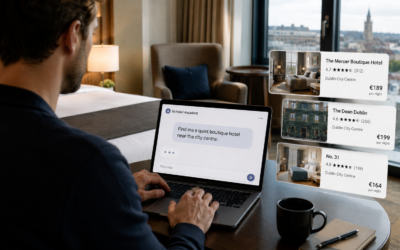
The era of “one-sided” optimization is ending. As we move further into the age of agentic AI, travellers are no longer just using search engines; they are deploying their own Autonomous AI Agents. This creates a new “AI vs. AI” marketplace that changes the rules of engagement. While tools like PROS and IDeaS continue to optimize for the provider’s bottom line, the traveller’s agent is now optimizing for the user’s wallet and preference and accessing data that was previously only available to the provider.
This was bought into focus recently amongst the Velocity Ventures portfolios. During a call with Jiha Jung, the founder Tripbtoz, he updated on some new features at the Korean social media driven OTA. One caught my attention – a low-price guaranteed tool. Here’s how it works: Travellers are often weary of locking in a hotel booking in case prices fall in the future. With the new Tripbtoz tool, travellers will be able to book a hotel room with an AI price monitoring option that will automatically rebook the room if the rate drops between the initial booking and travel. The price difference is credited back to the traveller’s Tripbtoz wallet, driving improved customer satisfaction through knowing lowest price is guaranteed; and return business to the OTA to spend the wallet credit. During the same week we were updated on our portfolio company Zuzu’s new revenue optimization tools for small and medium sized hotels by founder, Vikram Malhi. These AI tools automatically monitor room rates offered by competitor hotels (ie similar location and star-rating) on either OTA’s or direct hotel.com sites. They then look at the forward occupancy of the Zuzu hotel customer and determine, based on historic booking patterns, what new rates to offer in order to maximise revenue; and then push them to market automatically via Zuzu’s channel management.
These are examples of the shift in dynamics that are likely to drive change in three specific ways:
The End of “Panic Booking”
Dynamic pricing thrives on human emotions, the fear that a price will rise if you don’t click “Buy” now. Or the fear of booking too soon and missing a deal – the Tripbtoz example. AI agents don’t feel fear! They utilize predictive analytics to know, with statistical certainty, if a price is likely to drop or increase. An agent can “hold the line,” waiting until 3:00 AM on a Tuesday to execute a booking when the provider’s algorithm dips, effectively neutralizing the “urgency” lever used by travel brands.
Real-Time Negotiation Agents
We are seeing the rise of agents that don’t just “find” a price—they negotiate it. New platforms allow AI agents to communicate directly with a provider’s RMS via API. If a flight managed by Amadeus has significant unsold inventory close to departure, your AI agent can “bid” a lower rate in real-time. This forces providers away from static “fare buckets” toward a fluid bidding model where prices are settled by machine-to-machine handshakes in milliseconds. Agents also have access to huge data pools that were once only the purview of the travel provider. These can be accessed at almost zero cost to assist the traveller to optimise their booking decision making.
Neutralizing Browser Fingerprinting
Traditional dynamic pricing often tracks your device and location to guess your “willingness to pay.” AI agents act as a privacy buffer. They query prices through clean, standardized interfaces, preventing travel providers from “profiling” the user to inflate costs.
The Future of “Collaborative” Pricing and the Loyalty Shift
How will hotels and airlines respond when they can no longer easily “game” the individual traveller? The industry is shifting from predatory pricing to collaborative value. The leading tools – IDeaS, Amadeus, and PROS – are already beginning to adapt, moving toward “agent-aware” systems that recognize when they are talking to a machine rather than a human.
From “Price” to “Bundle Value”
Because AI agents can compare thousands of variables instantly, providers are realizing they can’t win on base price alone. Instead, they will use AI to offer dynamic bundles—personalizing a package that includes a flight, lounge access, and carbon offsets specifically for your agent’s request. The “winning” price will be the best “value” – not necessarily the lowest but the one that offers the highest “Utility Score” to the AI agent.
The “Agentic” Loyalty Program
In the past, loyalty was about points. In the future, it’s about data permission. If you grant an airline’s AI access to your personal AI agent’s preferences, they can offer a “Pre-Negotiated” price. This creates a “lock-in” effect where the traveller gets a guaranteed fair rate without the “chess game,” and the provider gets a guaranteed booking.
Predictive Supply-Side Shifts
Finally, industry players are moving toward Collaborative AI Revenue Management. Instead of just reacting to search spikes, they are using AI to work out traveller demand. Velocity Ventures’ portfolio company Zytlyn is working on this by accessing huge and varied data pools (search data, weather patterns, school holidays, major event schedules….100s of data sets) and providing airline and hotel customers demand forecasts that are extremely accurate. If the Zytlyn agent signals that flight demand from London the Singapore is increasing next Februrary, airlines can adjust their flight schedules, fuel purchasing, staff rostering and pricing proactively rather than waiting for bookings to pile up and reacting on the back foot.
The Bottom Line
For the first time in the digital age, the “transparency gap” is closing. Travel discovery is moving from a high-stress hunt to a high-speed negotiation between two intelligent systems. For the traveller, this means lower prices and less friction; for the industry, it means a desperate race to ensure their data is “AI-readable” or risk becoming invisible to the agents of the future.