
Authored by Venkat Chamarthi, Jameson Ho
From Getting Funded to Getting Bought
In What Makes a Travel-Tech Startup Investable in 2026?, we argued that travel investors have moved away from funding growth at all costs. They now want to see a clear path to EBITDA, strong unit economics, revenue that grows from existing customers and data that an incumbent cannot easily copy. This piece looks at how investors get their money back.
For most of the last decade the assumed exit for startup investors was an IPO. A handful of category leaders can still go that way, but most travel startups will be sold to an airline, a hotel group, an online travel agency (OTA), a payments company or software company. That changes how VCs assess a deal. Investors now want to know who would buy a company and what that buyer would be paying for.
The Narrow IPO Window
Only the largest travel companies have managed to list recently, and their shares have struggled. Navan priced its IPO at $25 in October 2025 and fell to around $8.50 within five months. HBX Group, the owner of Hotelbeds, also still trades below its IPO price of €11.50. Klook filed to list in New York in November 2025 but reportedly postponed within weeks because of weak debuts from peers.
Southeast Asia in particular faced a tough exit environment in 2025. PitchBook’s 2026 report on the region notes that investors in the region are no longer constrained by a lack of investment opportunities but by the difficulty of exiting those investments through IPOs and acquisitions. Out of 58 VC exits in 2025, only 7 were public listings. The rest were acquisitions and buyouts. PitchBook’s midyear update suggests the region’s venture market has started to stabilise in 2026, but it still stands that acquisitions are the most likely path to exit.
Who’s Buying, and Why
The four main groups of buyers want quite different things.
Airlines buy few startups. When they do spend outside flying, holiday businesses are a common target. Qantas paid A$211 million in 2024 for the 49% of TripADeal it did not already own, expecting at least A$50 million a year in synergies. Startups selling software to airlines are more likely to be bought by the carriers’ suppliers, which private equity has been consolidating. In late 2025 Thoma Bravo bought Boeing’s Jeppesen and ForeFlight businesses for $10.55 billion, and PROS, whose airline pricing business it now runs as a standalone company, for $1.4 billion.
The big hotel groups have been buying brands. Marriott paid $355 million for the citizenM brand in 2025 and IHG paid €110.5 million for Ruby, both without taking on any property. Hotel technology tends to be bought by the software vendors that sell to hotels, such as Mews, which acquired the AI analytics firm DataChat in 2025.
Among the OTAs, Expedia has been one of the most active, agreeing to buy the attractions platform Tiqets in December 2025 and the car rental distributor CarTrawler in May 2026 for its B2B business. Listed Asian companies are buying too. TBO Tek paid $125 million for Classic Vacations, and ixigo agreed to buy 60% of Spain’s Trenes. For most startups the problem is size. Morgann Lesné of Cambon Partners told PhocusWire that for the largest OTAs, “You need to be worth hundreds of millions to be interesting.”
Payments and software companies are the most varied group. Flywire paid $330 million for the hotel payments platform Sertifi, and Shift4 bought Global Blue, the tax-free shopping operator, in a deal valued at about $2.5 billion. Capital One agreed in January to buy Brex for $5.15 billion and plans to integrate Brex’s spend-management platform with Capital One Travel. Mobility platforms and new types of investors are buying too. Uber agreed to buy the chauffeur platform Blacklane in March, and Long Lake, which calls itself the world’s first “AI holding company”, completed its $6.3 billion take-private of Amex GBT in September.
Tech-Led vs. Revenue-Led Deals
Buyers pay either for technology or for revenue, and the two are valued differently.
| Tech-led | Revenue-led | |
| What the buyer is buying | Technology or a team it would otherwise have to build | Customers, supply or transaction volume |
| How the price is set | The cost and time of building it | A multiple of revenue or EBITDA |
| What it means for the startup | Value is capped; suits capital-light companies | Value scales with revenue and profit |
Most of this year’s tech-led deals have involved AI. Revenue-led deals are larger, and buyers judge them on the metrics covered in What Makes a Travel-Tech Startup Investable in 2026?, such as take rate, net revenue retention, the payback period on customer acquisition and the path to EBITDA. TBO Tek’s $125 million price for Classic Vacations was about 11 times the business’s 2024 operating EBITDA.
The distinction should shape how much a startup raises. A capability purchase can be an excellent result for a company that has raised $3 million. For one that has raised $50 million, the same offer may leave little or nothing for founders and early investors once liquidation preferences are paid.
Where the Buyer Universe Is Deepest
Buyers are most plentiful in B2B categories where software handles bookings or payments, and scarcest for consumer apps.
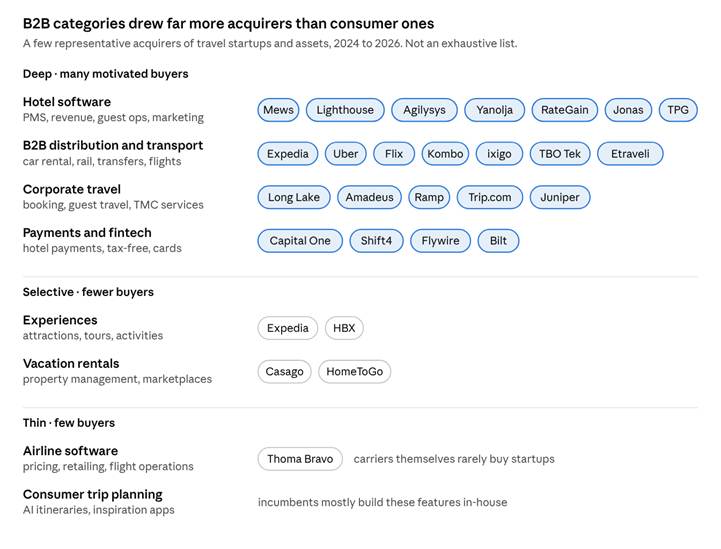
Buyer universe by subsector, 2024–2026 · a few representative acquirers, not an exhaustive list
Hotel software has the widest field, including PMS vendors, data providers, listed software companies and private equity-backed consolidators. Korea’s Yanolja bought India’s InnKey in May to expand into the Middle East and Southeast Asia. Corporate travel now attracts fintech buyers alongside travel management companies, and ground transport is consolidating quickly. Airline software and consumer trip planning have the fewest buyers. Carriers rarely buy startups. Consumer trip planners face a risk we described in Part 1. If an incumbent can copy the product within a single product cycle, it has little reason to pay a premium for the startup.
None of the acquirers named in this piece is based in Southeast Asia, which bears out PitchBook’s point about the region. A startup here needs to be known to buyers in the US, Europe, India, China and Korea, and that usually means working with them commercially long before any sale.
What should founders do differently?
A founder who cannot name five companies with a strategic reason to buy the business is relying on an IPO, so that list is worth drawing up early. Commercial relationships or smaller investments usually come first. Yanolja, for example, bought InnKey four years after making a strategic investment that came with a right to acquire.
Buyers also pay more for products that are easy to integrate and that carry payments revenue. Finally, the cap table needs to always be managed in such a way that it is ready for a sale. As our recent piece on CarbonClick showed, a stack of convertible notes can derail a planned merger.
Who is well placed in an M&A-led market?
Strategic buyers have reasons to stay active. Valuations are lower than a few years ago, and AI is pushing incumbents to buy capabilities they cannot build quickly enough.
In What Makes a Travel-Tech Startup Investable in 2026? we argued that, with capital harder to come by since interest rates rose in 2022, a VC’s value lies more in helping companies with strategy and operations than in winning an allocation in a funding round. An M&A-led market adds the job of knowing the likely acquirers well, down to who inside each one makes the decision. Sector-specific funds with long operating experience in travel and hospitality, such as Velocity Ventures, are well placed to make those introductions early and help portfolio companies get ready for a sale.